Showing posts with label Marvel Comics. Show all posts

Saturday, 28 June 2014

WHAT IF... Captain America was African American!?

If there's one topic that keeps popping up in terms of superhero movies lately, it's the idea of 'racebent', 'colourblind', or whatever other term you wish to label it with casting. This became something of a minor issue for the original Thor movie, when Heimdall, a character who traditionally looked something like this...


Wound up looking more like this...


And overnight became the number one way of telling who was a petty racist in the world of comic books and the movies that surround them. 

Of course, when the movie came out and the rest of the world saw what anybody who'd seen Idris Elba in anything did with the character, any murmur of the character being the wrong colour was soon forgotten (or at least sidelined to the point where the only rebut you'll ever need is a clip of Elba as Heimdall doing anything on screen) and it's also not the first, or last, time something like this has happened. Say what you like about Daredevil, but Michael Clarke Duncan's portrayal of Kingpin may well be the best representation that character we can hope for. Then of course there was Laurence Fishburne as Perry White in Man of Steel, an actor who sadly wasn't given the time to show us what he could do with that character, and the more high profile casting of Samuel L. Jackson as Nick Fury. Yes, I know it's a direct lift from the Ultimates universe, but still the point still stands. All these actors took on characters that are traditionally seen as white, and not only did the world not come to a horrific end, but the vast majority of them were nothing short of superb. 

Now the debate rides again, coming about as a more high profile white character, the Human Torch, has been cast as black actor Michael B. Jordan. Now I have to admit, I don't really have a horse in this race. The only thing I've seen with Jordan in is Chronicle and that was a movie with problems far beyond it's acting talent. Of course, the new Fantastic Four movie also has problems of it's own beyond the race changing of a single character that worry me, but I've been catching little pieces of the debate from time to time and when I heard that John Byrne had chimed in? Morbid curiosity got the better of me and I decided to go have a look. I refuse to link to that man's forum, but here's a Bleeding Cool link that about covers it. 

Now I have to admit, I went into reading this expecting to roll my eyes at best, or want to punch my monitor at worst, but despite missing the point in places, providing a genuinely awful example of this kind of casting in other kinds of movies and eventually devolving into the worst excesses of comic book fan entitlement that he blames the public representation of fans for in an earlier paragraph there are points I actually agree with him on, and I think it's one of the most sane and reasonable things I've read from the man on this kind of issue. I mean, he didn't brand a whole gender of a single race hookers just for the colour of their hair this time, so it's progress right? I suppose if I really wanted to take him to task, I'd argue that Stan Lee is big enough and old enough to speak up for himself and a man who writes a story about Big Barda being brainwashed into making hardcore pornography is the very last person who should be lecturing others on respecting Jack Kirby's characters. So wheeling out the whole 'Spirit of what Lee and Kirby intended' is just... Bollocks, quite frankly. But I digress. 

The two things I really took away from all this is the complete agreement that Marvel and DC should be doing more to promote their minority characters. Cripes, doing more to promote their female characters would be wonderful. However I don't think giving Nick Fury an obscure, coloured SHIELD agent as a sidekick is really as powerful a step forward as having one of the top black actors of our time playing the character who is most associated with counter-intelligence in the Marvel universe. Yet I do feel like Marvel in particular could be doing so much more with the minority characters they've already introduced. While War Machine and Falcon are unlikely to be able to support their own movies (yet!) I do have to ask, why wasn't War Machine in Avengers? Pepper Potts was, and she's not even Tony's superheroic partner! Or more importantly, why is there seemingly no sign of Falcon in Avengers 2? He was still with Steve at the end of the movie, surely if there's anyone Rodgers would want to have his back it would be the man who helped him save SHIELD from itself simply because it was the right thing to do. 

The other thing Byrne's comments left me pondering was exactly what makes race important to a character, and how interchangeable it is. Hollywood is pretty ruthless with changing nationalities, or casting actors of one nationality to play a character of another, is this really any different? To me, the answer seems to be 'it depends'. Does it really matter what colour Johnny Storm's skin is? Not really, although it would be nice if they cast Sue as the same race. Yes I know even biological siblings can have different skin colour, but to be honest I'd rather they just cast them both black or both white than having to waste movie time explaining why they are as they are. The important part of Storm's character comes from his firebrand, fun loving personality and the powerful bond he shares with his family - And that's something that transcends skin colour. Heck, somebody in the comments on that article mentioned Reed Richards being played by Denzel Washington and I have to admit... I would be all over that. 

But as I climbed down the rabbit hole, there were some characters where a change of skin tone would fundamentally change them at the core. This became most apparent with time locked characters. Technically as leader of the Howling Commandos, this should have been Fury. But naturally you can't have him stealing Cap's shtick on screen, and I think this, more than his race accounts for a lot of the problems with the character Byrne brought up. He doesn't have his history, his dyed in the wool pedigree like he does in the comics - It simply doesn't work here. So really, we know very little about him other than the fact he lurks around the Helicarrier and gives orders. It's something I'd love to see them expand on, and I'm very glad he finally got some great focus in The Winter Soldier.

Speaking of Cap though, how different would that movie have been at it's very core had they cast a black actor as Steve Rodgers? How many social issues would they have had to tackle head on or look silly for straight up ignoring? His back story could almost be untouched, just take on a more poignant element for the fact that not only are big, dumb jocks getting him down for being too weedy to do well... Most anything really, but society itself is telling him he's a second class citizen. So this runty little guy with no prospects whatsoever decides the only way he can make anything of himself is by joining the army. Literally, the only way.

Of course, this is where the movie could perhaps borrow a lot of elements from the backstory of Isaiah Bradley, an African American who was part of a test program to recreate the super soldier program during World War II. Now you might ask why not just make a movie about Isaiah Bradley, then? Because I think there's something inherently more interesting about the government choosing to test their maiden voyage with this project on minorities, and then rolling it out to get their golden haired, blue eyed, perfect Aryans and other assorted pretty white boys once they knew it was safe. The problem with Isaiah Bradley is he's never going to have the same impact as Captain America, because they already have their perfect product. If that initial experiment that Thorin Oakenshield was so discourteous to disrupt with explosions had only produced a single, solitary super soldier - And he was a person of colour? Well, where does the American government go from there?

Can they still use him as a propaganda piece like they did with Rodgers in the movie? Or do they just package him off on secret, behind enemy lines mission and be content they have a pretty powerful weapon in the war - Just one they'd rather not everybody see! You also have to wonder what Cap himself would do. Would he just roll with whatever his military superiors told him to do, or choose to use his new found power and influence to fix some things at home as well as abroad? There's a great sentiment in the first Captain America movie, where after a life of being pushed around and watching other people be pushed around, Steve Rodgers has dedicated the rest of his days to fighting bullies big and small and sees very little difference between Red Skull and his cronies and the big, dumb guys who made his own life hell other than the scale on which they work. What happens when the people who made your life hell have the law on their side in some circumstances? Hrm. 

Now, I just want to be clear I'm not advocating that this movie should be made. I personally find the idea fascinating, and if pulled off well it would definitely be a thought provoking and potentially eye opening piece. But for somebody who's favourite superhero movie so far is, indeed, Captain America the first, it wouldn't really make for a good punchy, dynamic comic book action movie. Plus I'm a big fan of keeping characters true to their source material on a basic level, I like all the core elements and broad brush strokes to be there to make the character recognisable, while film makers can go wild on the less important things. I just think that when it comes to race? If changing it is a big deal or not really does depend on the extent it effects the character. 

Nobody is going to care if Aquaman isn't white. Heck, with the casting of native Hawaiian Jason Momoa as the king of Atlantis I think we're going to confirm that for a fact very soon indeed. He's Atlantean, he could technically be any colour he liked. But when you start messing with characters who have very strong connections to a certain culture, time period or geographical area? Then things start getting tricky, as you risk changing that character beyond recognition. The most obvious examples are the minority characters that already exist to try to bring some diversity to the titles, but if we want to step back to the Fantastic Four, think about Doctor Doom. He's the ruler of a small, Eastern European country through hereditary ties, could he really be anything else than what he is and still have it believable? 

At the end of the day though, it's all about one thing - Casting the best man or woman for the job at any given time, and if comic book movies can keep that up? Like they did with Sam Jackson, Michael C. Duncan and Idris Elba? Yeah, I can be a happy bunny and not get too pent up about this issue. Of course, if they don't, I choose less to think of it as an example of 'forced token casting' ruining our movies, and more just flat out bad casting period. I hope whatever happens with the new Fantastic Four movie, Michael B. Jordan is able to prove he's anything but that. 

Friday, 7 February 2014

Blog Monkey Read Comic.

If there's one thing I love, it's stories that have an element of Frankenstein's Monster about them. Things that rip, and tear, and rend their way through history, classic literature, decades of comic book continuity and then sew the pieces back together into a new whole. I wouldn't say they're my favourite stories, but I love them none the less. Part of this appeal is the 'Where's Wally?' level of fun to be had. Or Waldo, for our Trans-Atlantic friends. One of my proudest moments, when I was still becoming confident enough to tackle more complex, dare I say, 'adult' books was figuring out who Anubis and Thoth were before their true identities were revealed in American Gods and I don't think I've really outgrown the wonder of sifting through works like that, like Fables and like League of Extraordinary Gentlemen and either identifying who the various characters are supposed to represent, and if I don't know (as I didn't know Anansi at the time) finding out. Even when you know the general pool that the writer is drafting from, it can still take you by surprise. Afterall, one minute Allan Quatermain and Mina Murray are making love against a tree, the next...


... Is that... Is that Rupert the Bear, Alan Moore?!

I think this is part of the reason I'm as enthralled with superhero comics as I am. This whole notion of taking otherwise disparate characters that may only be linked by the tenuous bond of happening to be published in the same format and genre as the others is the cornerstone of the superhero team up book. Not to mention with most of the big names having seventy years of history, and even smaller tier characters usually having at least a decade or three behind them, one writers interpretation of a character in 1983 could be galaxies away from another in 1960, or even 2014. Stitching together the sordid history of Hawkman, as Geoff Johns attempted in Justice Society, was as much an act of pushing several different characters into one mould as any issue of Justice League or Avengers. I dread to think what would happen if one were to try and blend all of the various identities of the Question from Ditko up into one continuity and one, blank, unstaring face and we've already seen the maddeningly brilliant, and often just plain maddening, results of Grant Morrison trying to make every single moment of Bat-Continuity work in one incredibly disjointed line.

It's an amazing strength, and an incredible weakness really. It allows for even the most minor character to be reinvented anew, for the grand tapestry of continuity to be wound, unwound and rewound again as any writer or editor or artist sees fit, displaying a whole new, exciting work for the audience to behold. Of course, on the downside there are always those who much prefer how the tapestry used to be, thank you very much! And even if one can forgive this, and roll with the punches, after so many alterations and re-airings even the most resilient tapestry starts to become frayed and faded. I'm put in the mind of something Paul Cornell once said regarding Doctor Who, that sometimes it does a franchise good to lay fallow, and the relevance that statement holds to many a big title out there, but that's perhaps a discussion for another day.

Image taken from aintitcool.com

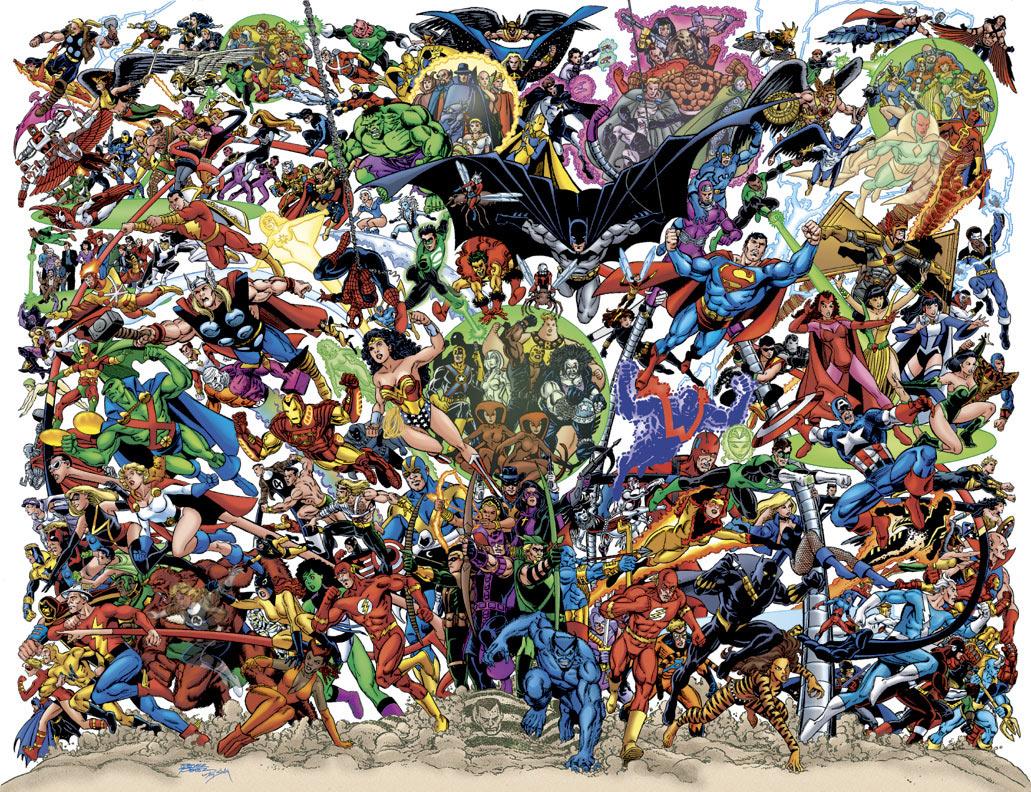
Failing all of the above, though, there's always just the ultimate expression of Where's Wally/Waldo? in comic media, the big battle scene/charge forward/team meeting where even if your most beloved character is only known by two people in the entire world, if one of those people is the writer of what you're reading? Chances are you'll find him! JLA/Avengers was practically pornography for this kind of thing, involving characters from across both of the big two in costumes from more eras than you can shake a stick at, and I have to admit... I loved it.

So given my now much ruminated on love of this kind of story, when I saw the Kickstarter page for Code Monkey Save World, I was in.

Code Monkey Save World, for those who don't know, is a comic book project by writer Greg Pak and musician Jonathan Coulton to transform Coulton's musical work into a story of fumbling heroism, inept villainy and unrequited love. You can read more about the project here. For those of you who have no idea who Jonathan Coulton is, well, this may ring a bell...


But he's oh so much more than just that one, albeit rather brilliant, song. Jonathan Coulton is a bard for the new age, a man who in days of yore would be telling grand tales of adventure and love and humdrum office work and the material worth of extremely fancy pants around roaring camp fires. And they'd also be rather amusing to boot! His songs are all quirky little stories in and of themselves, telling self-contained tales of colourful characters that will bloom to life in your imagination and, at the very least, put a smile on your face. The idea of these songs being brought to life in comic book form is alluring enough as it is, and Greg Pak, the writer behind the fantastically excellent Incredible Hercules series, is certainly the man to do it.


So, as the popular internet meme often cries, I shut up and I gave them my money.

Fast forward to a few months later, and a non-de-script brown envelope arrived at my door earlier today. Inside, I found the following:


I'd been reading Smoke and Mirrors all afternoon, and it seemed like the perfect antidote to the string of rather unsettling short stories that come after The Goldfish Pool. A literary palette cleanser, if you will. I was fairly excited, I'd only read the first issue on it's own, resolving to experience the rest of the story in one sitting. I'm glad I did, really, it read a whole lot more fluidly than my experience with reading the first issue alone.

You see, Code Monkey Save World is not really the kind of book that demands a keen eye in case you miss a small, hidden away reference or a character you think is an extra is in fact a wink to another song. There are some nice touches, and great detailing in the background. I love, for example, that the SCM company name is featured prominently in the first few pages - Giving those in the know a clue of what's to come, without being entirely too obvious. But for the most part, it focuses it's efforts on bringing to life a few characters and scenarios from a handful of songs with a laser keenness, rather than becoming a menagerie of tit-bits and nudge-nudge-wink-wink references from across Coulton's discography.

Instead it exemplifies the other reason why I love these kinds of stories, the way they allow writers to take existing ideas and characters that were presented in one way and then expose them to whole new elements not possible in their original incarnation. It would be like throwing Sherlock Holmes into Hogwarts, or Darth Vader into King Arthur's court. You may not get anything particularly good from it, you may even be completely dismissive of it in principle, but if it existed and was put into the right pair of creative hands, well, you'd want a peek, wouldn't you? I know I would.

The one thing I think Pak has done extremely well in this project, is to take just the right elements from just the right songs so that all the stories are allowed to interweave and entwine together to make something wholly unique, but still feeling very true to the original voice of the music. This isn't just spot the song reference, it's taking the stories from Jonathan Coulton's songs and carefully stitching them together into something else. To the point where I can happily listen to The Future Soon and imagine, very clearly, that the poor, hapless, lovesick soul in that song, is one and the same person as the maniacal super villain from Skullcrusher Mountain. And to be honest, I think that's a much greater achievement, that must have taken a hell of a lot of careful planning and work connecting the various dots, than a cursory read of the comic would imply.

Couple this with some good, but not perfect, characterisation, an upbeat tone of sly humour throughout and some very clean, very beautiful art from Takeshi Miyazawa and for me, at least, this is something I'm very proud to have had a hand in making happen. I notice the spine of the book has a little '1' on it, and if this creative team intends to do more in future? I'll definitely be game at throwing them some more money, and look forward to seeing what other songs they want to not only bring to life, but breathe a whole new life of their own, into next.

Final verdict? It most definitely puts the rock in the house!


Thursday, 9 January 2014

Alan Moore, knows the score... Or does he?

So, something I wrote in my last post got me thinking. It's a topic I'm almost afraid to touch, because I know I have friends who feel very strongly on the matter, and it's hardly timely, but I promised weekly blogs (to myself, if nobody else!) and this is what has been buzzing around my brain this week. So here we go!

Last post when I wrote about Day of the Doctor, I mentioned in passing Doctor Who's inclusivity and how, at it's best, it had something for everyone. This got me thinking about something that got the internet somewhat riled a few months ago, when a snippet of an Alan Moore interview was posted around various comic book sites. In this interview, Alan Moore had the audacity to say... Well, see for yourself...

 "I hate superheroes. I think they're abominations. They don't mean what they used to mean. They were originally in the hands of writers who would actively expand the imagination of their nine- to 13-year-old audience... These days, superhero comics think the audience is certainly not nine to 13, it's nothing to do with them. It's an audience largely of 30-, 40-, 50-, 60-year old men, usually men. Someone came up with the term graphic novel. These readers latched on to it; they were simply interested in a way that could validate their continued love of Green Lantern or Spider-Man without appearing in some way emotionally subnormal... I don't think the superhero stands for anything good. I think it's a rather alarming sign if we've got audiences of adults going to see the Avengers movie and delighting in concepts and characters meant to entertain the 12-year-old boys of the 1950s."
 You can read the full interview at the Guardians website here, where Alan has a nice chat about the most recent project with his name attached and has a little pop at Grant Morrison to boot. But what you see above is the majority of the "offensive" material, and many comic book sites chose to cut it down even smaller than that, to a sentence or a snippet.

Now, let's make a few things clear. Alan Moore doesn't hate superheroes. I know he just said he did above, right up there, in black and white but he later clarifies he hates what they've become, 'they don't mean what they used to mean... I don't think the superhero stands for anything good'. At the time I also argued that, perhaps, he didn't mean to say that enjoying these things as an adult was emotional subnormal. Afterall, how could he? Alan Moore is a fan of what superhero comics used to be, if not what they are today, and will talk for hours about Shuster, Siegel, Ditko and Kirby with the best of them. In fact, he does so in great detail in this video about Stan Lee's contribution to Spider-Man. If those with a vested interest in superheroes in their adult years are emotionally subnormal, then he must be too. Which can't be right, can it? But in the time since, I've changed my mind. I think Alan Moore meant every word but he doesn't care about appearing emotionally abnormal for the things he loves, and nor should we. Surely, that's the very lifeblood of geek culture, right there?

Stripping away all the bitterness and the purposely confrontational tone, Alan Moore's point is fairly simple. The modern audience for superhero comics has come to expect their entertainment to grow with them and adapt into something that suits their more adult tastes, rather than evolve into something that may capture the imagination of a modern audience of children in the same way that comic books entranced him as a child. Some might see this as a good thing, some might wonder, in the face of competition such as video games and the internet, what else publishers can do but indulge their older audiences but for Moore this is a problem.

And... I'm surprised to find that on thinking about it, I actually agree with him.

Now don't get me wrong, I'm very much a lover of modern superhero comics and until I was forced to slash my comic budget to next-to-nothing I was picking up a good twenty-to-thirty titles a week. While I was collecting, I loved them. I enjoyed the highs of Geoff Johns Green Lantern enough to ignore the lows, I despaired at the cancellation of Doom Patrol and L.E.G.I.O.N. (still two of the best superhero titles in years, in my opinion) and I despaired that the current Legion of Superheroes titles in the new 52 didn't really seem for me. But as I was reading, I started to notice a problem. It first hit me in Batman, and it hit me quite hard years ago, just after HUSH was published. All the stories were becoming very similar, all built around the central pillar of 'MY PARENTS ARE DEEEEEEEEAD!!!' angst that Bruce feels, all concerned with misery and dwelling on mistakes and something very peculiar was happening to the villains. They seemed to becoming more brutal, more savage, embracing taboos such as cannibalism and self-mutilation to make them seem more frightening. They were becoming alarmingly savage, and to be honest... Sometimes it was a very tough read.

Taking a few steps back I started to realise, this isn't something that's particular to Batman. It was rife in the DC titles I was reading. Green Lantern featured Black Hand blowing his own brains out, very graphically, on panel. Supposedly minor characters were being butchered in increasingly gory and creative ways to up the stakes in big events and make the new, big villain look all the more scary and ruthless. Barry Allen, a light hearted man with a healthy relationship with his wife and two parents very prominently in the frame was suddenly made an orphan, now driven by solving the murder of his mother that his father had been wrongly convicted for. Somewhere, somehow, in so many of the titles I was reading - It seemed as though the fun had either gone, or was increasingly being asked to take a backseat to the kind of drama, angst and graphic depictions of violence that, while I'd never say has no place in superhero comics, surely shouldn't be allowed to be this prominent.

Now, to be clear, I can only really talk with authority to what I read in DC comics. When it comes to Marvel, I'm not expert and for all I know, they're a haven of wonderful stories told in a way that's accessible to all. Although considering Sentry tore Ares clean in two in a gore laden double page spread and a couple of other, worrying story beats I caught drift of I can't say for sure. I'm also not saying that all superhero titles need to be child friendly, in fact (before you throw your Tiny Titans collections at my head!) my argument isn't that titles need to be child friendly at all - They should be family friendly. I can't help but think that if I can't pick up the core titles of Batman, Superman, Wonder Woman, Green Lantern, The Flash, all these staples of the superhero genre and be just as comfortable sharing them with a ten year old as I would an eighty year old, in the same way that I'd very comfortably settle down to watch Doctor Who with just about anyone of any age range without thinking, then surely there's a problem. It's the one point I certainly don't agree with Moore on, superheroes shouldn't be for nine-to-thirteen year old's, they should be for everyone, and right now they're failing even at that.

Now you can make all kinds of excuses for why the comics are heading down this road, and I understand them well, but as touched on in my last post - DC, and in turn Time Warner, are suffering from something more problematic. This attitude of making everything dark, of making everything violent and of creating heroes and villains who live almost solely in the extreme with no balance has seeped into their movies. If you showed the designs for many of Nolan's Batman villains to people with no context, I'm certain few would be surprised if you told them they were designs for the latest slasher movie. Nolan sacrificed much of what made Batman fun and unique, and also the pure charm of so many characters, to chase something that was gritter, more realistic, more... Grown up. Yes, it was a huge sales success, but it ties directly into what Moore was saying above. Man of Steel is almost as bad, it's a movie where nobody smiles and the stakes are defined by how many skyscrapers are toppled and how much visible destruction can be crammed on screen at any given moment. In terms of comic book lore and mythology it's a spot on adaptation, but in terms of heart and mortality? I'm quite convinced it has none. One has to ask the question, who are these films for? What is the prime target audience? And ultimately, is it right that a Superman movie, Superman of all things, is aimed more at teens and adults than at a more family orientated audience?

Never fear though, it's not all bad! Because there is another point on which I break with Moore, and that's on the example he uses. The Avengers, the good old, superhero team up that was years in the making. It's not the best of superhero movies, but it's most certainly one of the most accessible. While Marvel comics may (or may not!) be indulging in the same slow, depressing march to 'maturity' that DC are, their film studios have just been fantastic throughout. Mixing humour, action, the right amount of angst and drama to create fun movies that I believe can be enjoyed by almost everyone. The Avengers is as prime an example of this as any movie out there. While it didn't get all the characters right, and while I thought a couple of the performances and emotional beats fell flat, let's look at what that movie is. Bunch of guys in gaudy costumes get together to fight an evil demi-God in a gaudy costume, culminating in an alien invasion where all the heroes have to come together to ultimately stop a force that looks unstoppable and save the day. That! That right there is superhero comics in their purest form, ladies and gentleman. Add in some fun, light-hearted banter, a layer of sympathy for the villain and an understanding that the stakes aren't tied to the amount of people being torn apart or the number of buildings being toppled on screen and you have a winner.

For as much as I worry about the future of superhero comics, and in what direction we're headed in, Marvel's films give me hope that we're not entirely lost in the quagmire of wanting to be mature and realistic, yet not really understanding what those terms mean or how to pull them off in a mature or realistic way, that other products have been slowly sinking in for awhile. I can fully appreciate what Alan is saying, and I can agree with him, but where he only sees the mangling of superheroes into something ugly and misshapen with no redeeming qualities whatsoever - I see a serious problem that, hopefully with the advent of digital distribution and Marvel's film work, DC's animated products (which have been, by and large, fantastic in keeping a balance between the lighter and darker shades of superhero comics without over indulging in either) and even Warner's own Arrow - Which seems to take just enough from both movies approaches to create a very entertaining program - Will iron itself out as a younger audience becomes more engaged with the characters and these products are easier for them to get a hold of.